



Do you want to create a beautiful and functional interior design? To create a gorgeous and functional interior design, it is not just enough to choose some beautiful fabrics and arrange some furniture. You must be familiar with the basic principles of interior design and make use of them to create a space that really mirrors the people who live in it
The basic principles of interior design

1. Balance
By evenly distributing the elements, you can create a visual harmony that can result in balance. This can add a sense of equilibrium to your design. You can accomplish this in lots of forms such as utilizing shapes, colors, patterns and even textures.
To include balance in interior design, you can use 3 common ways. One of those ways is traditional symmetrical balance, which basically puts objects symmetrically on either side of a visionary central axis. On the contrary, Asymmetrical balance maintains the focal point on the visionary axis while permitting different and oddly numbered objects. The similarity of the dimensions of the objects is necessary in order to keep an evenly distributed visual weight. Typically, asymmetrical balance leads to a livelier and more natural feel. Ultimately, radial balance can be created by putting items around a focal point, which is typically a circle.

2. Unity
The unity principle is mostly concerned with one element which is utilized in design: uniformity or harmony. These involve having identical colors, patterns or textures, similar spacing of objects or repetition of elements to generate a visual continuation. Briefly, when elements are carefully selected, you feel that they join together greatly. For instance, if you have many different shapes and textures in a space, you can still generate unity by making use of just one color scheme.
3. Rhythm
The human brain is attracted to repetition and identifies similar objects rapidly. Hence, rhythm, which is focused on generating repetition and contrast in an interior, assists in distributing visual interest around the room. Rhythm can be created in different ways, like making use of one color or pattern at various intervals. For instance, you can utilize the blue color for a wall, and then use this color again on the dining chair cushions in order to create a repetition rhythm. You can also benefit from alternation to generate rhythm. If you are interested in adventure, you can use progression rhythm, which organizes elements in ascending or descending arrangement according to their size, color or other features.

4. Emphasis
This principle emphasizes that every room must have one central element as a focal point, and the other elements should complete the emphasis such that concentration is always on it. A big piece of furniture such as a grand piano, an art piece such as a painting, or a design feature like an accent wall can be an emphasis. It can also appear in the form of color, pattern or texture.

5. Contrast
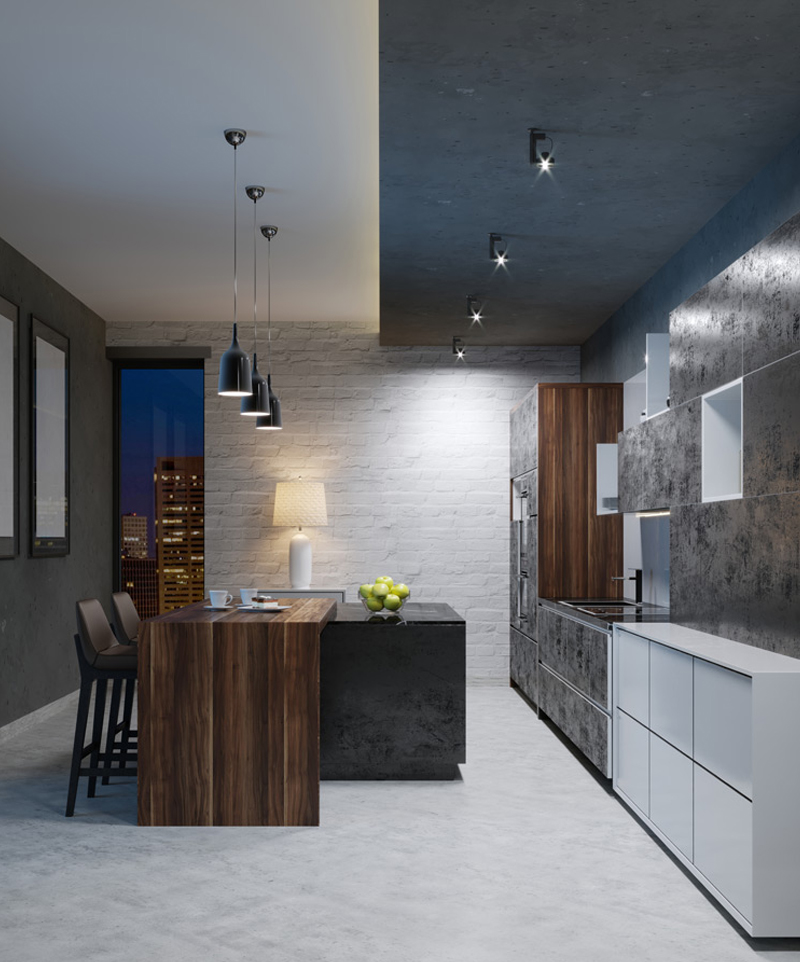
To create contrast in interior design, one or two or more very dissimilar forms must be combined. Again, it can be created by color, form or space. The simplest way to create contrast is via colors, for instance, by painting opposite colors such as black and white. You can also place two various shapes beside each other, like putting a round mirror in the vicinity of a rectangular dining table. The utilization of positive space and negative spaces is also a great way of generating contrast without cramming the room.
6. Scale and Proportion
This principle is completely related to ratio. The size and dimension of the objects in a room should be related rationally so that they will be in the proper position. For example, it is not reasonable to hang a big chandelier in a shoebox apartment, whereas a space with a high ceiling should have bigger furniture than bean bags.

7. Details
Every space must have details to raise it from simply ordinary to extraordinary. In interior design, details refer to those small elements that include interest, depth, and texture in a space. They can include decorative items, like vases, sculptures, and picture frames, to functional objects, such as knobs and handles, light fixtures, and textiles. The most important point about adding details to your space is to maintain it balanced. There is no need to do something unnecessary and crowd your space with too many details, or else it can become cumbersome and disorganized. Simultaneously, you must avoid being too much minimal and plain, or else your space may become monotonous and dull.

There are some tips for including details in your space:
Begin with a neutral palette. The biggest benefit of having a neutral base is creating a canvas for including details. You can incorporate many colors, patterns, and textures to make the space more attractive.
Layering is important. Layering various textures and patterns makes a space interesting. For instance, you can put various rugs on top of each other, combine and match various throw pillows, and add various fabrics to your window structures.
Generate a focal point. Make use of details to attract attention to a specific area of your space. A piece of furniture, an attractive work of art, or a textured wall can be that detail. By generating a focal point, you include visual interest and drama in your space.
Focus on lighting. Lighting is a very important element. Add various light sources, like floor lamps, table lamps, and sconces, to generate various moods.